
What Is SRT?
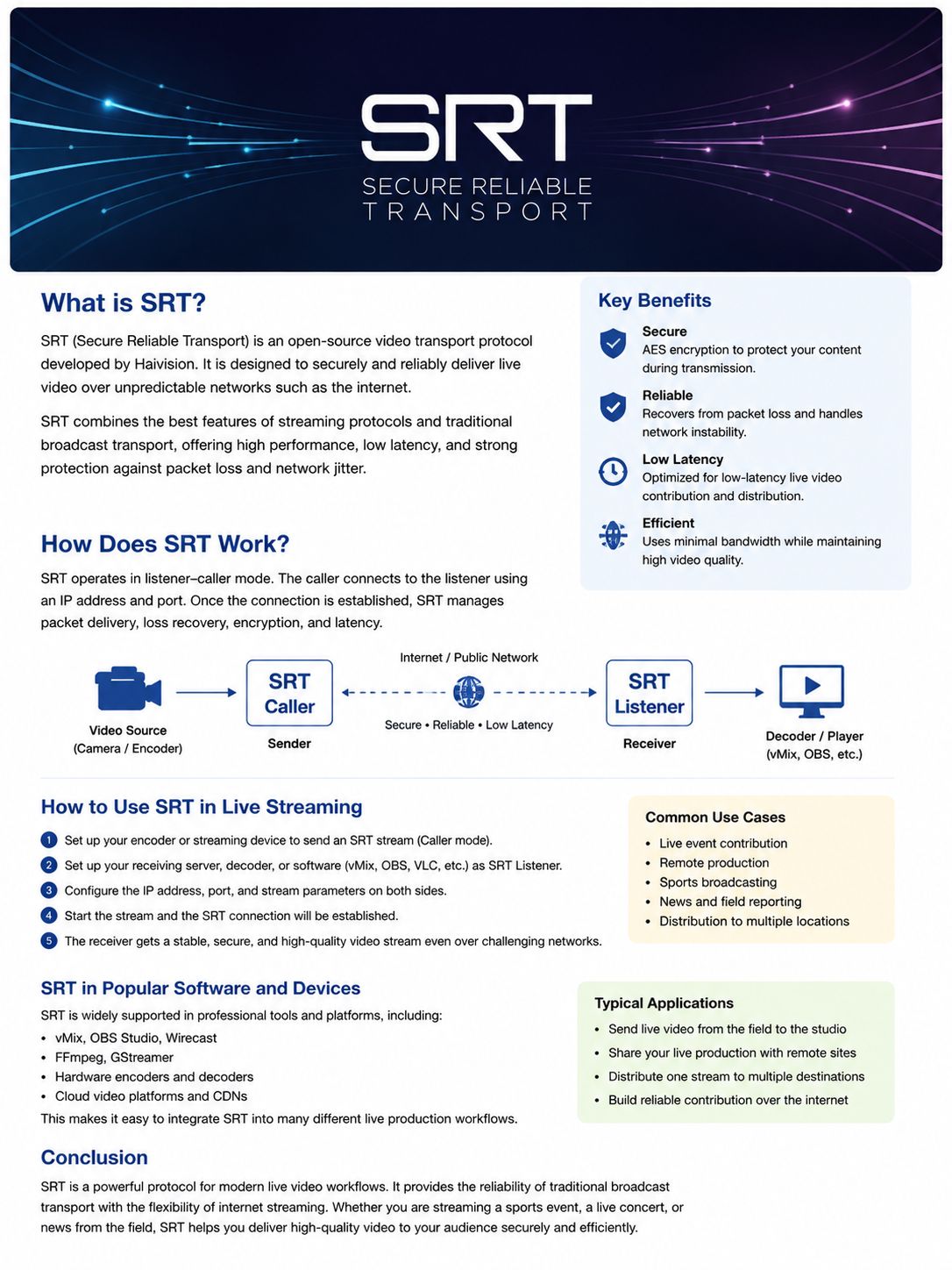
SRT (Secure Reliable Transport) is an open-source video transport protocol developed by Haivision. It is designed to deliver high-quality live video over unreliable or unpredictable networks, including the public Internet.
SRT combines low latency, reliability, security, and efficient bandwidth usage, making it an excellent solution for professional live streaming and remote video production.
Unlike traditional streaming protocols that can suffer from packet loss and unstable connections, SRT is designed to recover lost data and maintain a stable video stream even when network conditions change.
How Does SRT Work?
SRT transports video and audio between two locations over an IP network.
A typical SRT workflow consists of:
Camera / Encoder → SRT → Internet → SRT → vMix / OBS / Decoder
The device sending the video is commonly configured as an SRT Caller, while the receiving device operates as an SRT Listener.
SRT manages the connection and provides mechanisms for packet recovery, latency control, and encryption during transmission.
How to Use SRT for Live Streaming
SRT can be used to send a live video signal from almost anywhere to a production or streaming system.
For example, a sports broadcaster can place a camera at a stadium and use an SRT-compatible encoder or application to send the video through a 4G, 5G, Wi-Fi, or wired Internet connection.
At the production location, vMix or OBS Studio can receive the SRT stream and use it as a live video source.
A basic workflow would be:
Camera → SRT Encoder → Internet → SRT Receiver → vMix / OBS → YouTube / Facebook
This makes it possible to produce live events remotely without requiring a dedicated fiber or satellite connection.
Why Is SRT Useful for Live Broadcasting?
Low Latency
SRT is designed for low-latency video transmission. This is especially important for live sports, interviews, news, and interactive broadcasts where delays need to be minimized.
Reliable Transmission
One of the most important advantages of SRT is its ability to deal with packet loss. When network problems occur, SRT can retransmit lost packets instead of simply allowing the video stream to break up.
Secure Transmission
SRT supports AES encryption, helping protect video and audio while they are being transmitted over the Internet.
Works Over the Internet
SRT is particularly useful when dedicated broadcast infrastructure is unavailable. A suitable Internet connection can be used to transport professional-quality live video between locations.
Efficient Bandwidth Usage
SRT is designed to provide reliable video delivery without requiring unnecessarily large amounts of bandwidth, making it suitable for remote production environments.
SRT for Sports Broadcasting
SRT is especially useful for football, futsal, basketball, and other live sports.
For example, a camera operator can send a Full HD video feed from a stadium to a production computer located elsewhere.
The connection could use:
- 4G
- 5G
- Wi-Fi
- Fiber Internet
- Ethernet
- Other IP networks
The receiving production system can then use the SRT feed inside vMix or OBS Studio for switching cameras, adding scoreboards, graphics, replays, lower thirds, and other broadcast elements.
SRT with vMix and OBS
SRT can be integrated into modern production software such as vMix and OBS Studio.
In vMix, an SRT stream can be added as an input and used like other video sources. This makes it possible to receive remote cameras, contribution feeds, or video from another production computer.
OBS can also receive SRT streams through compatible configurations and tools, allowing SRT to become part of a flexible live production workflow.
Example: Remote Sports Production
Imagine a futsal match taking place in a sports hall.
A camera sends video to an SRT encoder. The encoder transmits the signal through a 4G or 5G connection.
The video travels through the Internet and reaches a production computer running vMix.
The operator can then:
Receive SRT → Add Scoreboard → Add Graphics → Replay → Switch Cameras → Stream Online
The final program can then be delivered to platforms such as YouTube or Facebook.
SRT vs Traditional Streaming
SRT is different from common Internet streaming protocols because it was specifically designed with professional video contribution and unreliable networks in mind.
It provides features such as:
- Packet loss recovery
- Low latency
- Encryption
- Network resilience
- Reliable video transport
- Flexible IP-based workflows
This makes SRT particularly suitable for sending live video from the field to a studio or production center.
Conclusion
SRT has become an important technology for modern live video production. It allows broadcasters to transport high-quality video over standard IP networks while maintaining reliability, security, and low latency.
For sports broadcasters and live production teams using vMix or OBS, SRT provides a practical way to connect remote cameras and production locations using Internet connections such as 4G, 5G, Wi-Fi, and fiber.
Whether you are broadcasting a football match, a futsal tournament, a conference, or a live event, SRT can provide a reliable connection between the production location and the broadcasting system.
No comment